Wednesday, January 11, 2012
Lambing has started!
Just a quick note to announce the beginning of lambing. The girls have started things off with a BANG! Two sets of triplets were born this morning - a white and a natural colored set. 5 of the 6 lambs are boys, and they are all doing well. The natural colored triplets were already dry and fed by the time I made it out to the barn this morning, but only one of the white ones was on the ground. By the way his mother was calling and circling, I knew that there were more in the pipeline, and sure enough, within the span of the next 40 minutes, she produced two more. The good news is that both of these mothers can count (not always a given in the ovine world.) Sometimes a sheep mom can't count above "2" and she refuses to accept that she has given birth to 3 children. Convincing her otherwise can be an arduous task. Both of these ewes have plenty of milk, so it looks like supplementing won't be necessary.
Sunday, December 11, 2011
Continuing Education
We put a great deal of emphasis on education in our household.....and sometimes I also like to take classes, to keep my mind sharp and to learn a new skill or brush up on an existing one. This past fall, I had the opportunity to enroll in a 2 day workshop at Anderson Fiber Works over in Gresham, OR - just on the far side of Portland. Jen Anderson (of Hanks in the Hood) and her husband Tyler created Anderson Fiber Works earlier this year and it is a great place to shop for original dyed rovings, batts and yarns. Here is a cowl I made from a Hanks in the Hood batt:
In any case, I signed up for a workshop with Jaycee Boggs. The topic was making creative and unique yarns. The class took place in the upstairs of Anderson Fiber Works and there were around 20 of us:
The atmosphere was very friendly and creative......apparently some of us were more prepared than others to get those artistic juices flowing. I had never seen one of these before and it instantly made its way to the top of my Christmas wish list.
Using fiber from Hanks in the Hood/Anderson Fiber works, we spun a range of funky yarns, with a focus not only on the unique nature of the construction, but also on durability and usefulness. I personally think this is important when putting together a handspun yarn of any kind. If I spend that much time to make something, I want it to last for more than a couple of months. Below on the left is a single and on the right is that same single after it has been put through a plying process which includes some pushing, pulling and changes in tension between the right and the left hand that strained my brain but left me feeling that I had learned something new and fun.
In any case, I signed up for a workshop with Jaycee Boggs. The topic was making creative and unique yarns. The class took place in the upstairs of Anderson Fiber Works and there were around 20 of us:
The atmosphere was very friendly and creative......apparently some of us were more prepared than others to get those artistic juices flowing. I had never seen one of these before and it instantly made its way to the top of my Christmas wish list.
Using fiber from Hanks in the Hood/Anderson Fiber works, we spun a range of funky yarns, with a focus not only on the unique nature of the construction, but also on durability and usefulness. I personally think this is important when putting together a handspun yarn of any kind. If I spend that much time to make something, I want it to last for more than a couple of months. Below on the left is a single and on the right is that same single after it has been put through a plying process which includes some pushing, pulling and changes in tension between the right and the left hand that strained my brain but left me feeling that I had learned something new and fun.
Wednesday, October 5, 2011
The Start of the Rainy Season
Here in western Oregon, the weather has changed - the rainy season is upon us. How strange that we can go from dry 90 degree weather to the cool damp of clouds and rain and know that we will not shift back until June of the next year. The change happens quickly - one day you walk out the door and you know that the rainy season has arrived.
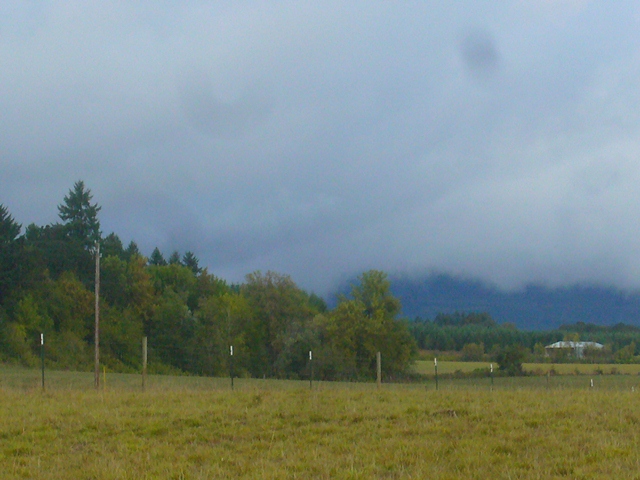
As you can see from this photo, the fields are still quite green. The long, wet and mild Spring allowed most of our grass to survive through the summer. Usually the hot and dry temperatures of August and early September cause the grass to go dormant. However this year, there was enough moisture in the ground to allow the pastures to remain productive. Part of the trick is to spend the money on good seed which is later maturing, so it does not bolt and go to seed in early June. Our adult brood ewes are out in the fields and won't require grass hay until we pull them off in another couple of weeks so that lime can be applied to counteract the acidity caused by leeching from our long and wet winters.
On my way up to the biggest pasture, my two frisky ram lambs, came to visit. They are the best of this year's crop of ram lambs and they get to grow all winter and then be shown as yearlings - I hope to bring them to the National Lincoln Show & Sale in Estes Park, CO next June. One is a lovely silver while the other is a soft black color. As you can see, photographing sheep is like taking a picture of a dog - all you get a lot of the time is nostrils!
As you can see from this photo, the fields are still quite green. The long, wet and mild Spring allowed most of our grass to survive through the summer. Usually the hot and dry temperatures of August and early September cause the grass to go dormant. However this year, there was enough moisture in the ground to allow the pastures to remain productive. Part of the trick is to spend the money on good seed which is later maturing, so it does not bolt and go to seed in early June. Our adult brood ewes are out in the fields and won't require grass hay until we pull them off in another couple of weeks so that lime can be applied to counteract the acidity caused by leeching from our long and wet winters.
On my way up to the biggest pasture, my two frisky ram lambs, came to visit. They are the best of this year's crop of ram lambs and they get to grow all winter and then be shown as yearlings - I hope to bring them to the National Lincoln Show & Sale in Estes Park, CO next June. One is a lovely silver while the other is a soft black color. As you can see, photographing sheep is like taking a picture of a dog - all you get a lot of the time is nostrils!
On the way back down the alley, I realized that I still had eggs in my barn coat pocket. My youngest is helping care for the chickens - he sells the eggs under his business name of "Nick's Chicks." The children have had a great time thinking up a logo design for this fledgling enterprise. The dark brown egg is from our lone Welsummer hen. The reason that she is the only one is because our young guard dog discovered how the joy of using chickens as chew toys......No old or slow chickens left.
Thursday, September 8, 2011
Jerry the Mouse
Apparently my summer blew up when the children ended their school year. To be fair, June is always busy leading up to the Black Sheep Gathering in Eugene, but this year, I spent the month of July preparing to go away on what we fondly call a non-hospital vacation during the first half of August.
Three weeks ago while at a horse barn, I heard a strange noise coming from the hay stack. What I thought was a bird, turned out to be two orphaned baby field mice, crawling about looking for their mother. As the barn cat sat about 2 feet from where this scene was playing out, I think we can all guess what happened to Mama Mouse. I scooped them up and brought them home - Tom was slightly larger and his eyes were already open a little. Jerry's eyes were closed but both babies had some fur. I watered down some puppy formula from a previous (failed) mouse raising experiment - those we found in the carburetor of the riding lawn mower, an indication that we had not been diligent about mowing the lawn. In any case, as always, the children asked me if the babies were going to survive and I answered "I don't know" while thinking "heck no."
Here is a photo of Jerry in my daughter Maya's hand, the day after he came home to live with us.
After 24 hours, both Tom and Jerry were doing well, drinking puppy formula from a tiny eye dropper. However after 48 hours, something was clearly wrong with Tom, and he died on day #3. Fast forward 3 weeks later and Jerry has surprised us all.......we are now the proud parents of a slightly tame field mouse who likes to eat scraps from the dinner table and comes out of his nest when you call his name. Meet Jerry the Mouse.
Three weeks ago while at a horse barn, I heard a strange noise coming from the hay stack. What I thought was a bird, turned out to be two orphaned baby field mice, crawling about looking for their mother. As the barn cat sat about 2 feet from where this scene was playing out, I think we can all guess what happened to Mama Mouse. I scooped them up and brought them home - Tom was slightly larger and his eyes were already open a little. Jerry's eyes were closed but both babies had some fur. I watered down some puppy formula from a previous (failed) mouse raising experiment - those we found in the carburetor of the riding lawn mower, an indication that we had not been diligent about mowing the lawn. In any case, as always, the children asked me if the babies were going to survive and I answered "I don't know" while thinking "heck no."
Here is a photo of Jerry in my daughter Maya's hand, the day after he came home to live with us.
After 24 hours, both Tom and Jerry were doing well, drinking puppy formula from a tiny eye dropper. However after 48 hours, something was clearly wrong with Tom, and he died on day #3. Fast forward 3 weeks later and Jerry has surprised us all.......we are now the proud parents of a slightly tame field mouse who likes to eat scraps from the dinner table and comes out of his nest when you call his name. Meet Jerry the Mouse.
Monday, June 6, 2011
Felting Part II
This past weekend, I was very fortunate to be able to take a slipper felting class from Tash Wesp at the Sitka Center for Art and Ecology just north of Lincoln City. It is the first time I have taken a class there (frankly, I have just started taking classes again after a long hiatus) and I have nothing but good things to say both about the center as well as the class itself.
Tash (pronounced like "cash" but with a "t") makes all sorts of wonderful things with felt, including hats, shawls and vests. Our class introduced us to making slippers out of felt. We learned how to create a pattern that would fit our feet and how to enlarge it, to accommodate the shrinkage of the fibers as they were felted together. Here are my golden slippers - the flower petals on the top are cut from some prefelt I made, and the centers of the flowers were loosely needle felted prior to being incorporated into the design.
Friday, May 20, 2011
The Alfalfa Ethanol Connection
My sheep like to eat. During the Spring, Summer and Fall, they graze the grass growing on roughly 30 acres of our property. And in the winter, they chow down on grass hay (made from one of our pastures) as well as on alfalfa.
Alfalfa is the name of a small leafy plant from the pea family that is grown for the nutritional value of its leaves. Horses, sheep, cattle - they all love this stuff - it's like candy to them and it is an invaluable source of protein and calcium, which is why we feed it during the winter months.
Over thousands of years, humans have bred sheep to produce twins and grow fleece at the same time. This creates quite a draw on the body's resources and alfalfa helps to provide the additional nutrition during the last trimester of pregnancy and during the first 12 weeks of lactation. Feeding alfalfa and grass hay to sheep during the winter months are considered an acceptable part of a grass fed program.
Unfortunately, the price of alfalfa has been sky rocketing this year. At first glance, one might think that the higher cost of fuel is the culprit. However this is only a small part of the equation. Much more sinister forces are at work, namely the subsidization of ethanol. Corn prices are sky high and so more acreage is being devoted to corn production. This means that the demand for other grains is also increasing (the substitution effect) and those in turn are becoming more scarce and hence more expensive. All this has trickled down to the hay and alfalfa markets. 2 years ago, I could get good alfalfa for $140/ton and this year it is heading north of $200/ton. Raising livestock is not for the faint of heart!
Over thousands of years, humans have bred sheep to produce twins and grow fleece at the same time. This creates quite a draw on the body's resources and alfalfa helps to provide the additional nutrition during the last trimester of pregnancy and during the first 12 weeks of lactation. Feeding alfalfa and grass hay to sheep during the winter months are considered an acceptable part of a grass fed program.
Unfortunately, the price of alfalfa has been sky rocketing this year. At first glance, one might think that the higher cost of fuel is the culprit. However this is only a small part of the equation. Much more sinister forces are at work, namely the subsidization of ethanol. Corn prices are sky high and so more acreage is being devoted to corn production. This means that the demand for other grains is also increasing (the substitution effect) and those in turn are becoming more scarce and hence more expensive. All this has trickled down to the hay and alfalfa markets. 2 years ago, I could get good alfalfa for $140/ton and this year it is heading north of $200/ton. Raising livestock is not for the faint of heart!
Monday, May 9, 2011
The Trouble with Varmints
Raising grass fed lamb means trying to be a good shepherd and doing what's best for the grass in my pastures. The two are inextricably linked - one can't have one without the other. The sheep are good for the grass because they promote growth through healthy grazing and fertilizing. And the grass gives the sheep almost all of the important nutrients they need to grow and thrive. Note that I say "almost all" because the sheep still need a salt/mineral mixture that includes selenium - the Pacific Northwest is selenium deficient. Lambs born lacking selenium suffer from white muscle disease which can be lethal. And in the winter, when the ewes are pregnant or in the first 8 weeks of lactation, they get the extra protein and calcium they need from alfalfa (more on that in another post.)
Part of what keeps me busy at this time of year is trapping gophers. Gophers are smallish rodents that live underground and eat the root systems of the grass sward. The grass that has been targeted by these varmints dies and the result is (1) less grass in the pasture (2) nasty holes large enough for a sheep to break a leg in and (3) bare spots that encourage the growth of undesirable weeds that aren't eaten by sheep and detract from the value of hay. To me, gophers look a little bit like guinea pigs from hell - tiny eyes and ears, a short naked tail and teeth that rival a beaver's in size. Think naked mole rat with fur and you are half way there. Here are some photos I took out in the pasture that show how gophers damage the field:

Note the Canada thistle that has taken root in the bare spot in the photo on the right - this is a prime example of how invasive weeds can take advantage of gopher damage. Canada thistle has to be spot sprayed in order to kill it - it not only produces seeds that spread the plants but also creates an underground system of roots that can generate new plants in the immediate area.
"To catch a varmint, you have to think like a varmint." Sound familiar? This means figuring out where to place the traps. They look like this:
Despite the fact that there is a lot of gopher activity in the field, it helps to discern between where the varmints are eating and where they build their exit runs. The exit run is the best place to place the trap because gophers happen to be tidy little critters and periodically clean excess earth out of the back door. This is an exit run (notice that there is no "horse shoe" of earth around the hole) and in the next photo I have placed the set trap.


I know that it is not nice to think of killing creatures out in the field, but if it were your house and the mice were having a field day in the pantry you would clear them out of there in a hurry. If I were to let the gopher population go unchecked, it would have serious consequences to the functioning of the farm. So I turn into Bill Murray every Spring and wage an endless battle. Keep in mind that my traps catch gophers less than 50% of the time which means that I am routinely outsmarted by an animal with a brain the size of a lentil............
Part of what keeps me busy at this time of year is trapping gophers. Gophers are smallish rodents that live underground and eat the root systems of the grass sward. The grass that has been targeted by these varmints dies and the result is (1) less grass in the pasture (2) nasty holes large enough for a sheep to break a leg in and (3) bare spots that encourage the growth of undesirable weeds that aren't eaten by sheep and detract from the value of hay. To me, gophers look a little bit like guinea pigs from hell - tiny eyes and ears, a short naked tail and teeth that rival a beaver's in size. Think naked mole rat with fur and you are half way there. Here are some photos I took out in the pasture that show how gophers damage the field:

Note the Canada thistle that has taken root in the bare spot in the photo on the right - this is a prime example of how invasive weeds can take advantage of gopher damage. Canada thistle has to be spot sprayed in order to kill it - it not only produces seeds that spread the plants but also creates an underground system of roots that can generate new plants in the immediate area.
"To catch a varmint, you have to think like a varmint." Sound familiar? This means figuring out where to place the traps. They look like this:
Despite the fact that there is a lot of gopher activity in the field, it helps to discern between where the varmints are eating and where they build their exit runs. The exit run is the best place to place the trap because gophers happen to be tidy little critters and periodically clean excess earth out of the back door. This is an exit run (notice that there is no "horse shoe" of earth around the hole) and in the next photo I have placed the set trap.


I know that it is not nice to think of killing creatures out in the field, but if it were your house and the mice were having a field day in the pantry you would clear them out of there in a hurry. If I were to let the gopher population go unchecked, it would have serious consequences to the functioning of the farm. So I turn into Bill Murray every Spring and wage an endless battle. Keep in mind that my traps catch gophers less than 50% of the time which means that I am routinely outsmarted by an animal with a brain the size of a lentil............
Subscribe to:
Posts (Atom)