This past weekend, I was very fortunate to be able to take a slipper felting class from Tash Wesp at the Sitka Center for Art and Ecology just north of Lincoln City. It is the first time I have taken a class there (frankly, I have just started taking classes again after a long hiatus) and I have nothing but good things to say both about the center as well as the class itself.
Tash (pronounced like "cash" but with a "t") makes all sorts of wonderful things with felt, including hats, shawls and vests. Our class introduced us to making slippers out of felt. We learned how to create a pattern that would fit our feet and how to enlarge it, to accommodate the shrinkage of the fibers as they were felted together. Here are my golden slippers - the flower petals on the top are cut from some prefelt I made, and the centers of the flowers were loosely needle felted prior to being incorporated into the design.
Monday, June 6, 2011
Friday, May 20, 2011
The Alfalfa Ethanol Connection
My sheep like to eat. During the Spring, Summer and Fall, they graze the grass growing on roughly 30 acres of our property. And in the winter, they chow down on grass hay (made from one of our pastures) as well as on alfalfa.
Alfalfa is the name of a small leafy plant from the pea family that is grown for the nutritional value of its leaves. Horses, sheep, cattle - they all love this stuff - it's like candy to them and it is an invaluable source of protein and calcium, which is why we feed it during the winter months.
Over thousands of years, humans have bred sheep to produce twins and grow fleece at the same time. This creates quite a draw on the body's resources and alfalfa helps to provide the additional nutrition during the last trimester of pregnancy and during the first 12 weeks of lactation. Feeding alfalfa and grass hay to sheep during the winter months are considered an acceptable part of a grass fed program.
Unfortunately, the price of alfalfa has been sky rocketing this year. At first glance, one might think that the higher cost of fuel is the culprit. However this is only a small part of the equation. Much more sinister forces are at work, namely the subsidization of ethanol. Corn prices are sky high and so more acreage is being devoted to corn production. This means that the demand for other grains is also increasing (the substitution effect) and those in turn are becoming more scarce and hence more expensive. All this has trickled down to the hay and alfalfa markets. 2 years ago, I could get good alfalfa for $140/ton and this year it is heading north of $200/ton. Raising livestock is not for the faint of heart!
Over thousands of years, humans have bred sheep to produce twins and grow fleece at the same time. This creates quite a draw on the body's resources and alfalfa helps to provide the additional nutrition during the last trimester of pregnancy and during the first 12 weeks of lactation. Feeding alfalfa and grass hay to sheep during the winter months are considered an acceptable part of a grass fed program.
Unfortunately, the price of alfalfa has been sky rocketing this year. At first glance, one might think that the higher cost of fuel is the culprit. However this is only a small part of the equation. Much more sinister forces are at work, namely the subsidization of ethanol. Corn prices are sky high and so more acreage is being devoted to corn production. This means that the demand for other grains is also increasing (the substitution effect) and those in turn are becoming more scarce and hence more expensive. All this has trickled down to the hay and alfalfa markets. 2 years ago, I could get good alfalfa for $140/ton and this year it is heading north of $200/ton. Raising livestock is not for the faint of heart!
Monday, May 9, 2011
The Trouble with Varmints
Raising grass fed lamb means trying to be a good shepherd and doing what's best for the grass in my pastures. The two are inextricably linked - one can't have one without the other. The sheep are good for the grass because they promote growth through healthy grazing and fertilizing. And the grass gives the sheep almost all of the important nutrients they need to grow and thrive. Note that I say "almost all" because the sheep still need a salt/mineral mixture that includes selenium - the Pacific Northwest is selenium deficient. Lambs born lacking selenium suffer from white muscle disease which can be lethal. And in the winter, when the ewes are pregnant or in the first 8 weeks of lactation, they get the extra protein and calcium they need from alfalfa (more on that in another post.)
Part of what keeps me busy at this time of year is trapping gophers. Gophers are smallish rodents that live underground and eat the root systems of the grass sward. The grass that has been targeted by these varmints dies and the result is (1) less grass in the pasture (2) nasty holes large enough for a sheep to break a leg in and (3) bare spots that encourage the growth of undesirable weeds that aren't eaten by sheep and detract from the value of hay. To me, gophers look a little bit like guinea pigs from hell - tiny eyes and ears, a short naked tail and teeth that rival a beaver's in size. Think naked mole rat with fur and you are half way there. Here are some photos I took out in the pasture that show how gophers damage the field:

Note the Canada thistle that has taken root in the bare spot in the photo on the right - this is a prime example of how invasive weeds can take advantage of gopher damage. Canada thistle has to be spot sprayed in order to kill it - it not only produces seeds that spread the plants but also creates an underground system of roots that can generate new plants in the immediate area.
"To catch a varmint, you have to think like a varmint." Sound familiar? This means figuring out where to place the traps. They look like this:
Despite the fact that there is a lot of gopher activity in the field, it helps to discern between where the varmints are eating and where they build their exit runs. The exit run is the best place to place the trap because gophers happen to be tidy little critters and periodically clean excess earth out of the back door. This is an exit run (notice that there is no "horse shoe" of earth around the hole) and in the next photo I have placed the set trap.


I know that it is not nice to think of killing creatures out in the field, but if it were your house and the mice were having a field day in the pantry you would clear them out of there in a hurry. If I were to let the gopher population go unchecked, it would have serious consequences to the functioning of the farm. So I turn into Bill Murray every Spring and wage an endless battle. Keep in mind that my traps catch gophers less than 50% of the time which means that I am routinely outsmarted by an animal with a brain the size of a lentil............
Part of what keeps me busy at this time of year is trapping gophers. Gophers are smallish rodents that live underground and eat the root systems of the grass sward. The grass that has been targeted by these varmints dies and the result is (1) less grass in the pasture (2) nasty holes large enough for a sheep to break a leg in and (3) bare spots that encourage the growth of undesirable weeds that aren't eaten by sheep and detract from the value of hay. To me, gophers look a little bit like guinea pigs from hell - tiny eyes and ears, a short naked tail and teeth that rival a beaver's in size. Think naked mole rat with fur and you are half way there. Here are some photos I took out in the pasture that show how gophers damage the field:

Note the Canada thistle that has taken root in the bare spot in the photo on the right - this is a prime example of how invasive weeds can take advantage of gopher damage. Canada thistle has to be spot sprayed in order to kill it - it not only produces seeds that spread the plants but also creates an underground system of roots that can generate new plants in the immediate area.
"To catch a varmint, you have to think like a varmint." Sound familiar? This means figuring out where to place the traps. They look like this:
Despite the fact that there is a lot of gopher activity in the field, it helps to discern between where the varmints are eating and where they build their exit runs. The exit run is the best place to place the trap because gophers happen to be tidy little critters and periodically clean excess earth out of the back door. This is an exit run (notice that there is no "horse shoe" of earth around the hole) and in the next photo I have placed the set trap.


I know that it is not nice to think of killing creatures out in the field, but if it were your house and the mice were having a field day in the pantry you would clear them out of there in a hurry. If I were to let the gopher population go unchecked, it would have serious consequences to the functioning of the farm. So I turn into Bill Murray every Spring and wage an endless battle. Keep in mind that my traps catch gophers less than 50% of the time which means that I am routinely outsmarted by an animal with a brain the size of a lentil............
Tuesday, April 12, 2011
An Epiphany of Sorts
Do you sometimes get struck as though by lightning when an idea or concept zips through your head? I've had it happen a couple of times to me during my lifetime (all 43 years.) Once was while standing in the sleet and rain, staring at some beautiful dyed fiber in the window of a yarn store in Bethel, ME and realizing that I did not have to pay New York City prices for yarn - I could make it! And look what that led to - me armpits deep in sheep.
Well folks, it happened again recently. A good friend purchased a hand felted hat while visiting Eugene, OR and when I saw it, I had to hold it, to ogle it, to dissect it - something about the hat drew me like a bee to honey. It spoke to me. The hat was made by Tash Wesp and you can some of her work here. I became a woman on a mission - I had to felt. I have lived and breathed felt for several weeks now and the illness shows no sign of wearing off. And below are a couple of my first forays - enjoy!
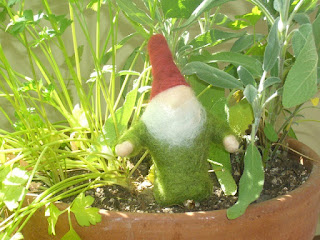
For the uninitiated, wool felt is created by taking advantage of the fact that fiber has scales, which when manipulated, can hook onto one another, creating a web and eventually felt. One can create the web through either wet felting, using water, soap and agitation or by dry felting which involves a very sharp needle with barbs. My first project is a garden gnome - he is wet felted and then I used a needle to anchor his hat a little more firmly to his head. Here he is hiding amongst some kitchen herbs.
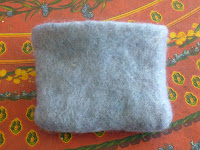
I then used a template made of foam to wet felt a small pouch using some of my own dyed Romney/kid roving. After the pouch had thoroughly dried, I lined it with some printed fabric.

I still thought it needed a little extra embellishment, so I added a daisy by needle felting it on. First the center of the flower, then a petal, then more.....
Here is what it looks like now:
And the gnome has found a new home!
Compose
Well folks, it happened again recently. A good friend purchased a hand felted hat while visiting Eugene, OR and when I saw it, I had to hold it, to ogle it, to dissect it - something about the hat drew me like a bee to honey. It spoke to me. The hat was made by Tash Wesp and you can some of her work here. I became a woman on a mission - I had to felt. I have lived and breathed felt for several weeks now and the illness shows no sign of wearing off. And below are a couple of my first forays - enjoy!
For the uninitiated, wool felt is created by taking advantage of the fact that fiber has scales, which when manipulated, can hook onto one another, creating a web and eventually felt. One can create the web through either wet felting, using water, soap and agitation or by dry felting which involves a very sharp needle with barbs. My first project is a garden gnome - he is wet felted and then I used a needle to anchor his hat a little more firmly to his head. Here he is hiding amongst some kitchen herbs.I then used a template made of foam to wet felt a small pouch using some of my own dyed Romney/kid roving. After the pouch had thoroughly dried, I lined it with some printed fabric.


I still thought it needed a little extra embellishment, so I added a daisy by needle felting it on. First the center of the flower, then a petal, then more.....
Here is what it looks like now:
And the gnome has found a new home!
Compose
Thursday, March 31, 2011
Frisky Ladybugs
October and April are the ladybug months here at our house. In October, they swarm in unbelievable numbers and try to get in. One can't open the door without having at least 5 zip in before it is closed again (which makes for some unfortunate accidents and flat ladybugs in the door frame.) They hide in the corners of the ceilings and in the lamps. My husband gets so frustrated, he starts to suck them up with the vacuum cleaner. When we had a light bulb burn out several weeks ago, we discovered that most of the ladybugs never leave after their winter nap......Here are some photos taken in October of our porch when the ladybugs are as thick as Wildebeest on the African Savannah.
The ladybugs wake up as the days get longer and the temperatures a little warmer. What was a stampede to enter the house in October reverses itself in late March - ladybugs flying about, bumping into windows and falling into our morning cup of coffee. We get so desperate to let them out, we fling open the doors and windows to help them escape.
Yesterday was an unusually nice day, which means that it only rained for part of the day and we saw temperatures above 55 degrees for the first time since January.......have I mentioned how much I love this Spring which is the 5th wettest on record as well as the coolest ever since they started taking measurements back in 1895! In any case, the possibility of seeing my shadow drove me outside to bring the sheep back onto the lawn for some grazing (the fields are still too wet.) And I saw a sight which makes me realize that Spring truly is around the corner, namely ladybugs getting frisky. After napping all winter, it turns out that these little guys have only one thing on their mind, and it's not eating a juicy aphid - it's creating more little ladybugs. So here we have the napping ladybugs:
And here we have the ones that have already woken up and are hitting the dating scene with a vengeance:
The sheep are oblivious to the hanky panky - they just want to enjoy the grass:
The ladybugs wake up as the days get longer and the temperatures a little warmer. What was a stampede to enter the house in October reverses itself in late March - ladybugs flying about, bumping into windows and falling into our morning cup of coffee. We get so desperate to let them out, we fling open the doors and windows to help them escape.
Yesterday was an unusually nice day, which means that it only rained for part of the day and we saw temperatures above 55 degrees for the first time since January.......have I mentioned how much I love this Spring which is the 5th wettest on record as well as the coolest ever since they started taking measurements back in 1895! In any case, the possibility of seeing my shadow drove me outside to bring the sheep back onto the lawn for some grazing (the fields are still too wet.) And I saw a sight which makes me realize that Spring truly is around the corner, namely ladybugs getting frisky. After napping all winter, it turns out that these little guys have only one thing on their mind, and it's not eating a juicy aphid - it's creating more little ladybugs. So here we have the napping ladybugs:
And here we have the ones that have already woken up and are hitting the dating scene with a vengeance:
The sheep are oblivious to the hanky panky - they just want to enjoy the grass:
Thursday, March 17, 2011
Probing (the soil)
There isn't really all that much for me to do on the farm at this time of year. The lambs have been born and are doing well - all 68 of them. And the sheep are bored in the barn because the pastures are too wet and immature for them to go out into the fields just yet. In fact, the cool temperatures and high rain fall of the last few months (thank you La Nina) mean that the grasses are growing more slowly than usual.
So when I have nothing to do but dust, vacuum clean and laundry, I find things to keep me busy outside. Grass growth is an integral part of what we do here at North Valley Farm. That means keeping the soil healthy and yesterday I picked up a soil probe from the local field man over in Carlton, so I could send in samples to see if we are low on any essential ingredients for optimal grass growth.
Here is a photo of the tools of the trade - a soil probe and a clean bucket. I walked approximately 30 acres of pasture and took close to 40 samples in the following manner: first one depresses the hollow end of the soil probe like this:
Then you hop onto the bottom of the probe with both feet like this:
Think pogo stick without the bounce. This pushes the hollow part of the probe down into the soil and you pull out your sample. The samples are collected in the bucket, mixed together, and then submitted for testing. We are going to test for soil pH as well as several essential nutrient and mineral levels. As you can see there is plenty of grass as well as clover, but it really isn't growing gangbusters yet and won't until we get warmer temperatures.It is a long walk back from the fields to the house. But it was good to be outside. I bet I know what the soil tests will tell me - that I have to spend lots of money! Pete and I will work on varmint control next. I've gotten pretty handy with the gopher traps...............
Friday, March 11, 2011
My Dog Pete
Given the horrific earthquake and resulting tsunami that hit Japan yesterday, I want to start this entry by expressing my heartfelt sympathy for all those touched by this disaster. As a friend of mine wrote me today, it reminds us of how precarious our existence on this small blue and green marble can be.
Speaking of friends, I want to introduce you to my dog, Pete. As is common in this part of the country, we have many dogs - 5 to be exact. Some are serious dogs - those are the guard dogs that live with the sheep, and some are not so serious - that would be our Basset Hound with the Napoleon complex. And now we have added Pete. Pete is a Border Collie and I am starting to think that he is the smartest dog in the world. I hate to admit this, but Pete was an impulse purchase I found in a bin outside of Wilco right before Christmas. If I am honest, it was actually our daughter Maya who pestered me into looking into the bin as only a teenaged daughter can do. So I looked in, and there was Pete. Actually, there were 5 wriggling Border Collie puppies, but we noticed Pete right away because of his calm manners. And this means a lot because Border Collies are not known for being calm. Here is a photo of Pete right after we brought him home.
He has grown quite a bit and we are enjoying working with him as he is very receptive to learning new commands. He knows how to sit, how to stay, how to drop a ball and how to hop onto a dining room chair....If given the chance, he loves to run outside and play with the other dogs in the barn. Now he has stretched out and looks like a gangly teenager.

Late this summer, he will go to Border Collie boot camp and learn how to help me load and unload lambs from the stock trailer. This will hopefully allow me to stop swearing like a sailor when it comes time to bring the lambs to the butcher. But until then, we are really having a fun time with our dog Pete. He doesn't realize that he looks quite ridiculous with pink spots over his nostrils, but we won't tell him.
Speaking of friends, I want to introduce you to my dog, Pete. As is common in this part of the country, we have many dogs - 5 to be exact. Some are serious dogs - those are the guard dogs that live with the sheep, and some are not so serious - that would be our Basset Hound with the Napoleon complex. And now we have added Pete. Pete is a Border Collie and I am starting to think that he is the smartest dog in the world. I hate to admit this, but Pete was an impulse purchase I found in a bin outside of Wilco right before Christmas. If I am honest, it was actually our daughter Maya who pestered me into looking into the bin as only a teenaged daughter can do. So I looked in, and there was Pete. Actually, there were 5 wriggling Border Collie puppies, but we noticed Pete right away because of his calm manners. And this means a lot because Border Collies are not known for being calm. Here is a photo of Pete right after we brought him home.
He has grown quite a bit and we are enjoying working with him as he is very receptive to learning new commands. He knows how to sit, how to stay, how to drop a ball and how to hop onto a dining room chair....If given the chance, he loves to run outside and play with the other dogs in the barn. Now he has stretched out and looks like a gangly teenager.
Late this summer, he will go to Border Collie boot camp and learn how to help me load and unload lambs from the stock trailer. This will hopefully allow me to stop swearing like a sailor when it comes time to bring the lambs to the butcher. But until then, we are really having a fun time with our dog Pete. He doesn't realize that he looks quite ridiculous with pink spots over his nostrils, but we won't tell him.
Subscribe to:
Posts (Atom)


